
PUBLICATION HIGHLIGHT · 2026 · Molecular Physical Chemistry Group
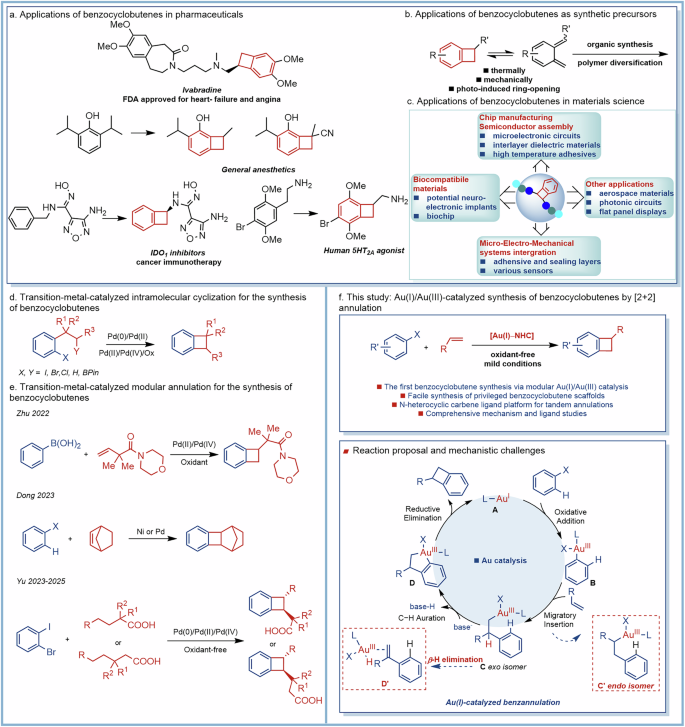
Błażej Dziuk is a co-author of a study in Nature Communications describing a gold-catalysed route to benzocyclobutenes, strained ring systems used as building blocks in synthesis and materials chemistry.
The reaction combines aryl halides and olefins through a [2 + 2] annulation without an external oxidant. Its selectivity depends on a specially designed C,N-bidentate N-heterocyclic carbene ligand, which modifies the electronic and steric environment around gold.
Experiments and density-functional calculations support a reaction pathway in which ligand design favours the desired bond-forming step and suppresses competing β-hydride elimination. The study illustrates how coordination chemistry can guide the development of selective synthetic reactions.
Publication
Pengcheng Gao, Jinzhao Wang, Wenchao Chu, Tongliang Zhou, Elwira Bisz, Błażej Dziuk, Roger Lalancette, Roman Szostak, Dongju Zhang, Michal Szostak. Ligand-Controlled Oxidant-Free Gold(I)/(III)-Catalyzed Synthesis of Benzocyclobutenes via [2 + 2] Annulation. Nature Communications (2026).